

- Created by admin, last modified by AdrianC on Feb 06, 2020
You are viewing an old version of this page. View the current version.
Compare with Current View Page History
« Previous Version 19 Next »
https://help.myob.com/wiki/x/kgzWAg
How satisfied are you with our online help?*
Just these help pages, not phone support or the product itself
Why did you give this rating?
Anything else you want to tell us about the help?
You can import an accounts list into MYOB to update the default accounts list. This is handy when you're setting up MYOB if you have an accounts list you've exported from another program or have it in a spreadsheet.
You can also export the accounts list from MYOB to use in another program. Exporting is also a quick way to create a template file which you can use to populate with your accounts info, ready for importing into MYOB.
Let's step you through it.
To import an accounts list
To import an accounts list into MYOB, the import file must:
- be a text (TXT) file
- be in tab-separated format
- contain a header row for all mandatory fields
- be under 20MB
To ensure your import file meets this criteria, we recommend using an import template. See To use an import template below for more details.
To import an accounts list
- Click your business name and choose Import and export data.
- On the Import tab, for the Data type choose Chart of accounts.
- Click Browse and locate the import file.
- Click the import file then click Open.
Select the method for handling duplicate records.
- Click Import.
To export an accounts list
- Click your business name and choose Import and export data.
- Click the Export tab.
- For the Data type choose Chart of accounts.
- In the Balances from field, choose the year you want the account balances to be reflected from.
- Choose the Account balances to be included in the export.
- Click Export. The file will be exported as a tab-separated TXT file. The first row will be a header row, listing all field headers.
To import accounts using a sample template
If you've exported your accounts list from another program, it might not be in the right format to import it into MYOB.
So we've created a sample template that contains a complete list of import-ready accounts which you can customise for your business. Just download the template, open it in Excel and modify the date, then import the file into MYOB.
- Open Microsoft Excel.
- Go to File > Open.
- For the type of file, select All Files(*.*). This ensures you'll be able to find your import template which is a text (.TXT) file.
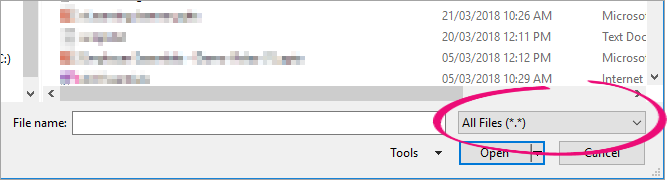
- Locate and open your exported text file. The Text Import Wizard appears.
- In Step 1 of the Text Import Wizard, select the Delimited option, then click Next.
- In Step 2 of the Text Import Wizard, select the Tab option, then click Next.
- In Step 3 of the Text Import Wizard, click Next.
Click Finish. The file contents of your template will be displayed. Notice in our example:
the first cell contains parentheses (brackets) - these need to remain, as they indicate that the import file is from MYOB.
the second row (beneath the row with the brackets) is labeled so you can easily work out what type of information is displayed in each column.
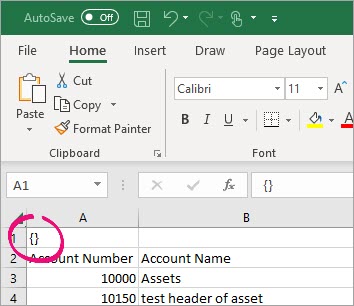
Enter your data in each applicable column. Remember:
- each column in the import file represents a field in MYOB
- each row in the import file represents a different account
- leave the brackets on the first row, and the headings on the second row.
When you're done, save the template as a text (.TXT) file. If you like, you can give the file a meaningful name, such as "Accounts List Import" or similar.

By importing the prepared template you'll overwrite the existing accounts list with the new accounts list from the file. Be sure this is what you want to do before proceeding.
- Click your business name and choose Import and export data.
- On the Import tab, for the Data type choose Chart of accounts.
- Click Browse and locate your import file template.
- Click the import file then click Open.
For the option If duplicate records are found, select Update existing data.
- Click Import.
 Yes
Yes
 No
No
 Thanks for your feedback.