

You are viewing an old version of this page. View the current version.
Compare with Current View Page History
« Previous Version 4 Next »
https://help.myob.com/wiki/x/FpawBQ
How satisfied are you with our online help?*
Just these help pages, not phone support or the product itself
Why did you give this rating?
Anything else you want to tell us about the help?
When a customer wants to buy goods or services from you, you can create a sales order for them. This will detail the selling price, quantity, and quality of goods or services provided. Later, when your items become available in inventory, you can invoice the customer and ship them.
Why use sales orders?
When you enter a sales order for inventoried items, they are are marked as committed to a sale. This helps your purchasing department make informed inventory ordering decisions. When you combine sales orders with the other inventory tracking features in MYOB Business, like purchase orders, inventory reports and stock reordering, your business gets a clear view on how much of your inventory is committed to sales, how much is on-hand and how much on order.
Sales orders help to ensure you can fulfil customer sales.
Creating a sales order
Go to the Purchases menu and choose Create purchase order.
Choose the Supplier you're ordering from.
- (Australia only) If the order will result in a reportable payment, select the option Report to ATO via TPAR. Learn more about Reportable contractor payments.
- Confirm the Shipping address where you want the order delivered.
If necessary, change the Purchase order number. This number is automatically generated, based on the last number used.
If you change the number, you’ll change the automatic numbering. For example, if you change the number to 000081 , the next time you create a purchase order, the new number will be 000082 .
- If you have a Supplier invoice number or Promised date from the supplier, enter these.
- Select whether the amounts in the order are Tax inclusive or Tax exclusive.
- Click the Field layout icon and select the applicable option based on what you're ordering.
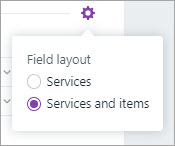
Enter details of the items and/or services you're ordering.
If you're ordering an item:
In the Item ID field, click the dropdown to choose an item or search for an item by entering all or part of the Item ID or Supplier item ID. As you type, matching items are shown.
Entering a new item?
Click the dropdown arrow in the Item ID column and choose + Create Item. Enter the item details and click Save. Learn more about Creating items.
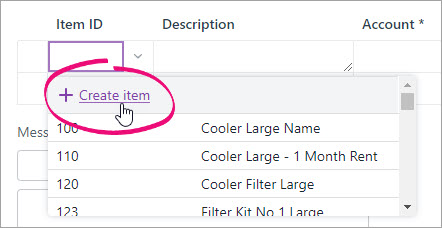
When you choose an item:its Description, Account for tracking purchases, Unit price and Tax code appear automatically, based on what you entered when you created the item (you can edit these details if you want).
the total price of the items is calculated automatically in the Amount field.
In the No of units field, enter the quantity to be delivered.
If you're paying a deposit on this order, enter it in the Amount paid field near the bottom.
Deposits on orders
If you want to apply a payment to a purchase order, you'll need to specify a linked account for tracking supplier deposits (Accounting menu > Manage linked accounts > Purchases tab > I track deposits paid to suppliers).
Learn more about linked accounts and supplier deposits.
Enter any charges for Freight, and if required, and if required, change the right Tax/GST code. If you can't enter Freight, you'll be prompted to specify a linked account for freight. (What is a linked account?)
The following totals are automatically calculated:
Subtotal—the total for the items added to the bill
Tax—the amount of tax applied to the bill
Total—the subtotal amount plus the tax amount
- Balance due— the amount owing.
- Balance due— the amount owing.
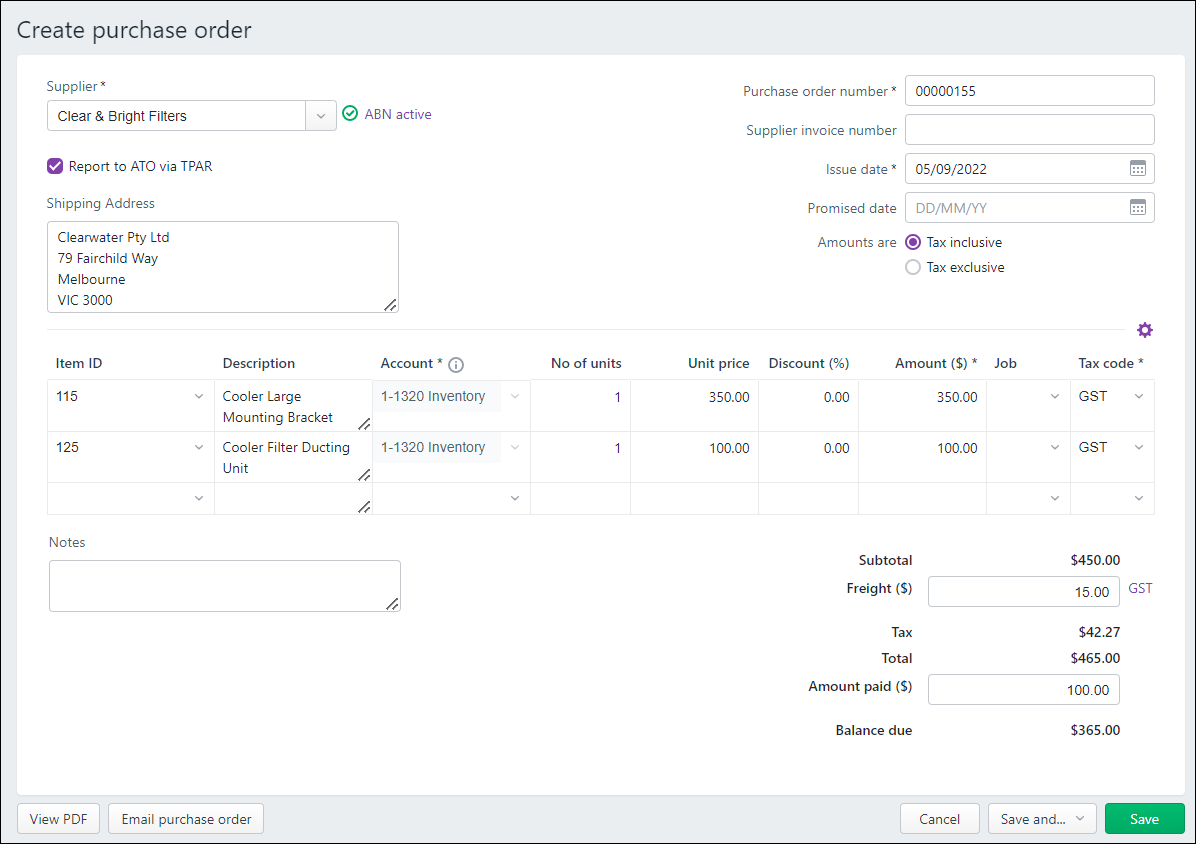
When you're done, use the buttons across the bottom of the page to choose an action.
If you want to... do this... Print or save a PDF copy Click View PDF and choose the template to generate the PDF (currently only invoice templates can be used) then click Export. The order appears as a PDF in a new tab where you can print or save it. Email the order Click Email purchase order, enter or check the details of the email and click Send purchase order. You can change the default purchase order email template by clicking your business name > Purchases settings. Learn more about Purchases settings Cancel without saving Click Cancel. Save the order and create a new one Click Save and... then choose Save and create new. The order is saved and a new, blank order appears. Save the order and create a duplicate Click Save and... then choose Save and duplicate. The order is saved and a new order with the same details and new order number is created. Save the order Click Save.
Once the supplier invoices you for what you've ordered, you can convert the order to a bill as described below.
Finding sales orders
Go to the Purchases menu and choose Purchase orders. You can filter the list of displayed purchase orders using the filters across the top, then click a purchase order number to view its details.
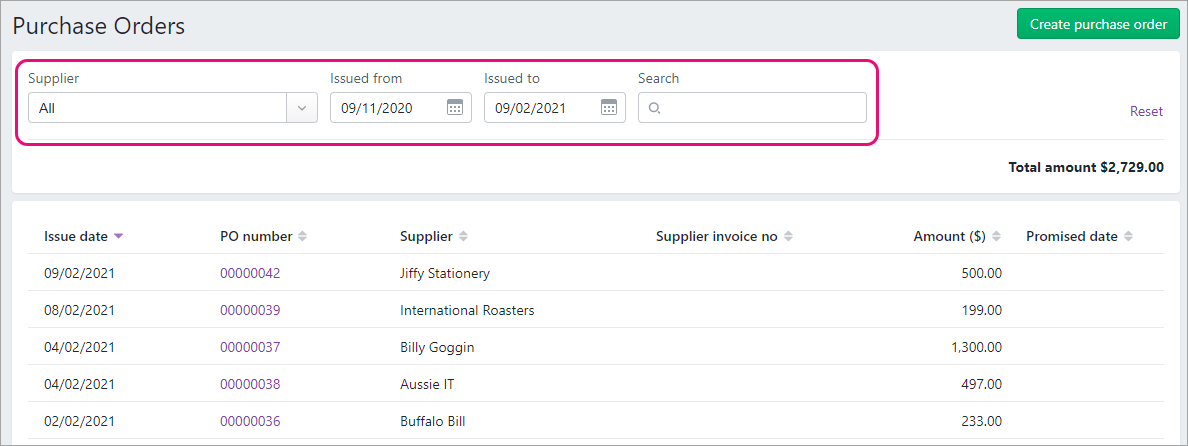
Once a purchase order is converted to a bill it won't show in this list. Instead, you'll see it in your bills list (Purchases menu > Bills). Find out about viewing bills.
Finding deposits
If you've applied a payment to a purchase order, before that order is converted to a bill the payment is considered a deposit. You can find your supplier deposits in the same way you'd find any other supplier payment.
Just check the Activity history at the bottom of the purchase order. You can then click the payment ID to see more details.

If you're after a list of deposits you've applied to multiple purchase orders, use Find transactions.
- From the Banking menu, choose Find transactions.
- Click the Transactions tab.
For the Source Journal, choose Cash Payments.
Source journals organise your accounting entries and make it easier to find transactions. Cash Payments source journals include things like money paid out, including supplier deposits.
- If required, use the other filters to narrow down the list. For example, use the Search field to search across any of the displayed columns.
- Click a transaction's reference number to view its details or edit it.
Changing or deleting a sales order
Need to change or fix something? Open the order and make your changes. You can change anything except the Supplier or the Amount paid value.
If it's easier, you can delete the order and start again.
To change a purchase order
- From the Purchases menu, choose Purchase orders.
- Click the purchase order you want to change. If needed, use the filters at the top to help find the order.
- Make your changes. You'll be able to change all details except the supplier.
When you're done, click Save.
To delete a sales order
You can delete a purchase order from the Purchase orders page (Purchases > Purchase orders). If a purchase order has a payment (deposit) applied to it, you'll first need to delete the payment before you can delete the purchase order (see the next task).
If the purchase order has been converted to a bill, learn about deleting bills.
To delete a purchase order:
- From the Purchases menu, choose Purchase orders.
- Click the purchase order you want to delete. If needed, use the filters at the top to help find the order.
- Click Delete at the bottom of the page.
At the confirmation message, click Delete.
FAQs
Who can enter sales orders?
Any user with the following role or permissions can enter purchase orders:
- Administrator
- Accountant/Bookkeeper
- Purchases
You can prevent an ordinary MYOB Business file user entering purchase orders by deselecting the Purchases role and permissions:
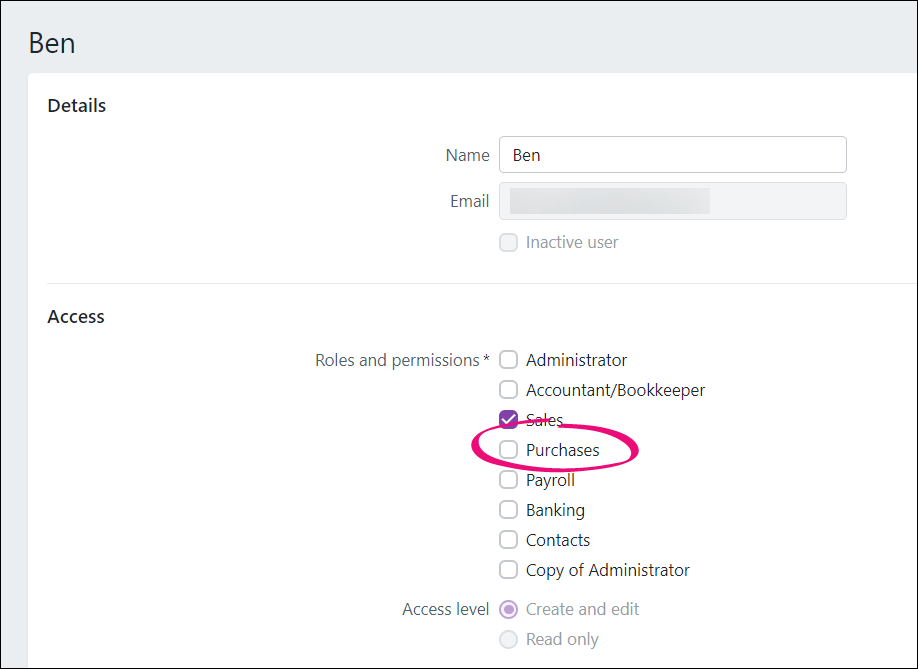
Find out more about user roles and permissions.
 Yes
Yes
 No
No
 Thanks for your feedback.